ServicesPrivacy Window Tinting
Privacy Window Tinting in Galveston
We install privacy window film that blocks the view into bathrooms, bedrooms, street-facing rooms and offices while still letting daylight through. We match the film type to when you need privacy, check your glass first, and photograph each window before and after.
How privacy film actually works
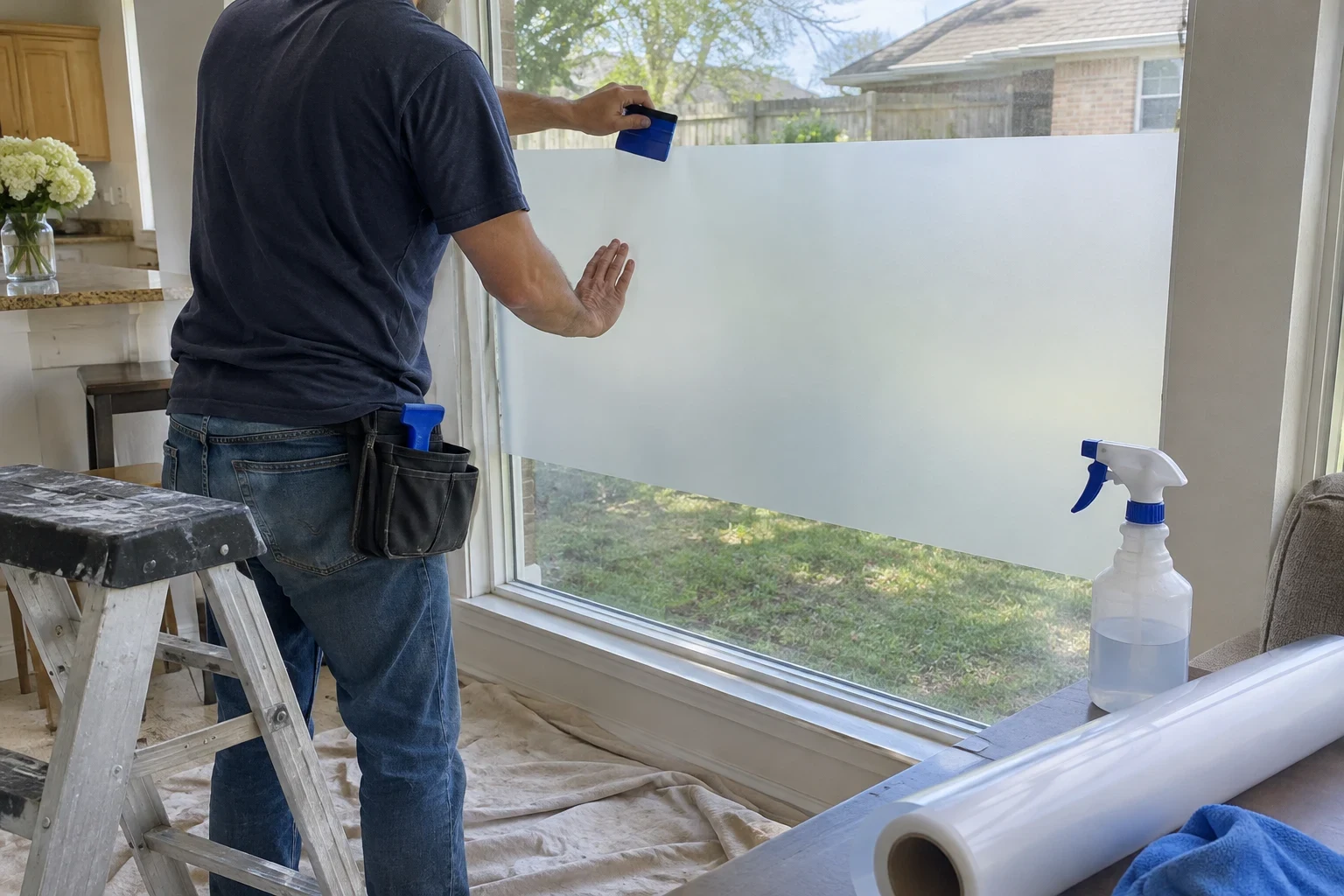
Privacy film works in one of two ways. Frosted, etched-look and blackout films scatter or block light, so they hide the view from both sides, day and night. Reflective one-way films use a thin metallized layer that acts like a mirror toward whichever side is brighter. That means they give strong daytime privacy, but at night, with your lights on, the effect reverses and people outside can see in.
Most people who call us want one of three things. Some need full privacy in a bathroom or a ground-floor bedroom. Some want daytime screening on a big front window without losing the view out. Others need to hide a conference room or reception desk from a parking lot. We sort out which goal fits each window before we recommend a film, and we tell you plainly where a reflective film will fall short after dark.
Along the coast, many houses sit close to the neighbors or face the street at eye level. In those cases a film that blocks sightlines without curtains pulled all day is often the simplest fix.
What the job includes
Glass check before any film
We look at whether each pane is single, dual-pane or low-E, and we look for failed seals and edge chips. Darker absorptive films heat the glass, and that heat can stress certain dual-pane units, so this check decides which films are safe to use.
Day and night sample test
We hold film samples against your actual windows so you can see the view from inside and from outside. For reflective films we explain what happens once your interior lights come on.
Photos of what we found
Before we start, we document each window, including any scratches, seal fog or damaged gaskets. You see the glass condition on record before film goes over it.
Wet-applied installation
Film goes on the interior surface with a slip solution, then gets squeegeed flat and trimmed with a small, even gap at the frame edge. That gap lets the glass expand and contract without lifting the film.
Cleanup and a finished record
We wipe down the sills, gaskets and frames, then photograph the finished windows so you have a record of what was installed and where.
Signs privacy film is the right call
Blinds stay closed all day
If you keep blinds shut just to stop people looking in, you lose daylight you would rather keep. Frosted or gradient film blocks the view and still lets light in.
Bathroom or shower window at eye level
Textured glass is often not enough, especially when wet. An opaque frosted film gives full privacy without the cost of replacing the glass.
Neighbors can see straight in
Closely spaced homes often have windows facing each other across a narrow side yard. A film on just those panes fixes the problem without darkening the whole house.
Glass office or conference room
Interior glass walls and street-facing offices expose screens and meetings. A frosted band at seated and standing eye height hides the room and keeps it bright.
Valuables visible from the street
If electronics, tools or inventory are visible through a window, blocking the view takes away the reason to look twice. For break-in resistance, see our security window film page.
How a privacy film install runs
- 1
Free quote by phone
You tell us which rooms and windows need privacy and when. We ask about the glass type and window sizes, then set a time to see them in person.
- 2
On-site check and samples
We measure every pane, inspect the glass and note its condition. You compare samples in place, and we give you a written estimate listing each window and the film chosen for it.
- 3
Prep and protection
We lay drop cloths below the windows and move nearby items back. Then we scrape and clean the glass, because any dust or paint fleck trapped under the film shows as a bump.
- 4
Install and trim
Each panel is cut slightly oversize, applied wet, squeegeed and trimmed precisely at the edges. When the last pane is done, we walk you through the result window by window.
- 5
Curing
Small water pockets or a light haze can show for a few days to a few weeks while the moisture evaporates. Cure time depends on the film thickness and how much sun the window gets. We tell you how long to wait before cleaning the film.
What moves the price of privacy film
Privacy film is priced by the window, not by a flat rate, so the estimate depends on what you actually have. We list each window and film on the written estimate so you can drop or add panes before we schedule. Here is what changes the number.
- Film type
- Basic frosted and blackout films cost less than dual-reflective, gradient or patterned films. Decorative patterns are covered on our decorative window tinting page.
- Square footage and pane count
- Total glass area matters, but so does the number of separate panes. Divided-lite windows take far more cutting and trimming than one large sheet.
- Access and height
- Transoms, stairwell windows and two-story glass need ladders or staging and extra setup time.
- Old film or glass condition
- Removing failed film and adhesive adds labor. Heavy scratches or paint overspray also take more prep before new film can go on.
Privacy film questions
Something not covered here? (409) 231-5848
Will people be able to see in at night?
With a reflective one-way film, yes, once your lights are brighter than the outdoors. Frosted, opaque and blackout films block the view both day and night. If you need nighttime privacy and still want a view out, we often pair a reflective film with shades, or use frosted film only on the lower part of the glass.
Can privacy film go on dual-pane windows?
Usually, but not every film is safe on every unit. Dark or highly absorptive films can heat the inner pane enough to stress the glass. We check the glass type and choose a film suited to it, and we will tell you if a particular window should skip film.
Does frosted film block heat too?
Standard frosted film is mainly for privacy and does little for heat. If you want both, a reflective film or a ceramic window film with a privacy layer can add heat rejection and UV protection. We explain the trade-off for each window.
Can the film be removed later?
Yes. Privacy film is applied to the inside of the glass and can be peeled off with steam and a scraper, then the adhesive is cleaned away. That makes it a good fit for renters or for an office that may change layouts.
How do I clean it?
After curing, use a soft cloth or rubber squeegee with mild soapy water. Skip ammonia cleaners and abrasive pads, which can haze or scratch the film's top coat.
Find out which film fits each window
We will look at your glass, show you samples in place and photograph what we find before any work starts. You get a written, window-by-window estimate to decide on.